
Identity Is the New Perimeter
As organizations move to cloud-based and distributed environments, traditional network boundaries no longer define security. This article explores why identity governance and disciplined access control are now central to reducing operational risk and strengthening overall security posture.
IDENTITY AND ACCESS MANAGEMENT
Ugochukwu Ezeakuji
2/18/20264 min read
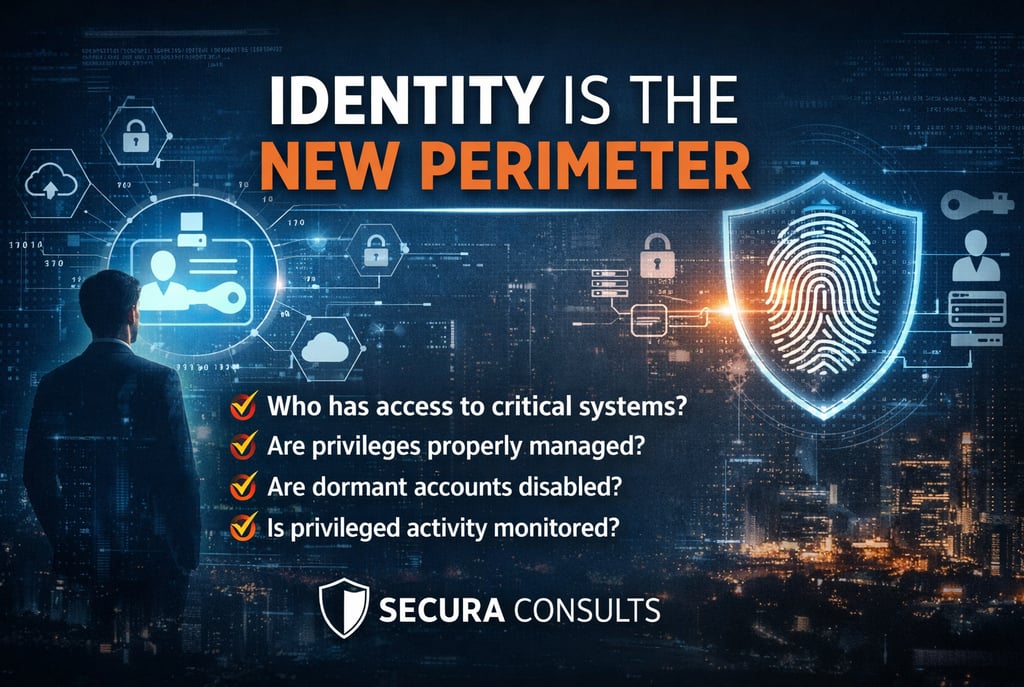
There was a time when network boundaries defined security.
If your firewall was properly configured, your VPN tightly controlled, and your internal network segmented, you were reasonably protected. Security strategies were built around protecting “inside” from “outside.”
That model no longer reflects how organizations operate.
Cloud platforms, SaaS applications, remote work, API integrations, contractors, managed service providers, and distributed teams have dissolved the traditional perimeter. Today, systems are accessible from anywhere. Infrastructure is dynamic. Data moves across platforms continuously.
In this environment, access — not location — defines exposure.
Identity is now the perimeter.
The Shift from Network Security to Identity Security
In a cloud-enabled environment:
Users authenticate from multiple devices
Applications integrate through APIs
Administrators manage infrastructure remotely
Vendors require access to internal systems
Privileged service accounts run automation processes
Security can no longer rely solely on IP ranges, network zones, or physical boundaries.
Instead, every access decision becomes a security decision.
Who can access a system?
At what privilege level?
Under what conditions?
For how long?
With what monitoring in place?
When identity governance is weak, risk expands quietly.
Most Incidents Begin with Access — Not Exploits
Organizations often focus on sophisticated attack narratives. In reality, many security incidents originate from far more ordinary weaknesses:
Over-privileged administrator accounts
Dormant or orphaned accounts
Shared credentials
Service accounts without rotation
Privilege escalation without review
Inconsistent offboarding processes
Access accumulates over time.
As organizations grow, roles evolve. Employees change responsibilities. Contractors come and go. Systems expand. New tools are integrated. Temporary access exceptions become permanent.
Without structured governance, privilege creep becomes inevitable.
Identity-related weaknesses are rarely dramatic at first. They compound quietly — until an internal error, credential compromise, or insider misuse exposes the gap.
Why Identity Governance Is Often Underestimated
Identity and access management (IAM) is frequently treated as a technical configuration domain. It is delegated to IT teams and revisited only when problems arise.
However, effective identity governance is not merely about provisioning accounts. It is a risk management discipline.
Organizations should be able to answer, without delay:
Who has access to critical systems?
Why do they have that level of access?
When was that access last reviewed?
Who approved it?
How is privileged activity monitored?
How quickly can access be revoked?
If answering these questions requires manual investigation, spreadsheet reconciliation, or ad hoc system queries, visibility is already insufficient.
Security maturity requires structured clarity.
The Risks of Privilege Creep
Privilege creep occurs when users gradually accumulate access rights beyond their current responsibilities.
Common drivers include:
Role changes without structured de-provisioning
Temporary elevated privileges left in place
Broad administrative roles used for convenience
Lack of segregation of duties
Informal access approval practices
Over time, the number of individuals with excessive access increases. So does the attack surface.
The risk is not theoretical.
Excessive privileges:
Increase the impact of credential compromise
Enable lateral movement within systems
Reduce accountability
Make forensic investigation more difficult
Create insider risk exposure
Identity governance is therefore not just about compliance. It is about limiting blast radius.
Access Control as a Governance Function
Access governance should not operate in isolation.
It must connect to broader security governance structures, including:
Risk management
Incident response
Change management
Vendor management
Board-level reporting
An effective identity governance model typically includes:
1. Clearly Defined Role Structures
Roles should align with real business functions, not generic technical groupings.
Access tiers should be structured based on:
Sensitivity of data
Criticality of systems
Level of operational authority
2. Formal Approval Workflows
Access approvals should be:
Tied to documented business need
Traceable to a responsible approver
Time-bound where appropriate
Logged and retained
3. Segregation of Duties
No single individual should control an entire critical process without oversight.
Segregation reduces fraud risk, error propagation, and systemic abuse.
4. Privileged Access Monitoring
Administrative actions should be:
Logged
Periodically reviewed
Subject to alerting where appropriate
Logging without review does not constitute monitoring.
5. Periodic, Risk-Informed Access Reviews
Access reviews should not be mechanical checkbox exercises.
They should assess:
Continued business necessity
Role alignment
Privilege appropriateness
Exception justification
6. Structured De-Provisioning
Offboarding processes must ensure:
Immediate revocation of system access
Termination of administrative privileges
Rotation of shared credentials where necessary
Exit processes are as critical as onboarding processes.
Identity and Operational Resilience
Identity weaknesses often remain invisible until stress events occur.
During incidents, identity clarity becomes decisive.
When responding to a security event, organizations must quickly determine:
Who has administrative access?
Which accounts are active?
Whether elevated privileges were used?
Whether service accounts were involved?
How far access extends across environments?
Organizations with mature identity governance can answer these questions immediately.
Those without it lose valuable response time.
Operational resilience depends on visibility and control.
Identity governance supports both.
Cloud Environments Increase Identity Complexity
Cloud-native architectures introduce additional identity risks:
Federated identity systems
Multi-cloud environments
Cross-account access roles
Automated infrastructure accounts
API tokens and integration credentials
Traditional access control models do not scale cleanly into dynamic cloud ecosystems.
Identity governance must evolve accordingly.
Organizations must maintain oversight not only of human identities but also:
Service accounts
Machine identities
API credentials
Integration tokens
Machine identities now outnumber human identities in many environments.
They require equal governance discipline.
Executive Oversight of Identity Risk
Identity governance is not solely a technical responsibility.
Executive leadership should understand:
The percentage of users with administrative access
The cadence of access reviews
The number of orphaned accounts identified during reviews
The time required to revoke access at exit
The volume of privileged activity monitoring exceptions
Identity risk is operational risk.
When governance is weak, exposure increases — even if perimeter controls appear strong.
Moving from Configuration to Discipline
Identity governance should not be reactive.
It should be embedded into operational practice.
Organizations seeking stronger security posture should focus on:
Designing access models intentionally
Monitoring privilege use consistently
Reviewing roles periodically
Eliminating unnecessary privileges
Treating access exceptions as risk events
Security maturity is rarely defined by dramatic improvements. It is defined by disciplined reduction of quiet weaknesses.
Identity is one of the most consequential of those weaknesses — and one of the most addressable.
Conclusion
The perimeter has shifted.
Network boundaries no longer define exposure. Access decisions do.
Identity now determines:
Who can see data
Who can modify systems
Who can disrupt operations
Who can escalate privileges
If identity is the new perimeter, then identity governance is foundational to effective security.
Organizations that treat identity as a strategic control domain meaningfully reduce risk. Those that treat it as background administration often discover its importance only after an incident.
Security effectiveness begins with disciplined control of access.
And in modern environments, access is everything.
Follow us on Socials
Phone
info@securaconsults.com
+2348035333281
© 2026. Secura Consults Ltd. All rights Reserved.