
NDPA vs GDPR: Key Differences for Data-Driven Organizations
This article compares the Nigeria Data Protection Act (NDPA) and the EU General Data Protection Regulation (GDPR), highlighting their similarities and key differences for data-driven organizations. It explains variations in scope, lawful basis requirements, data subject rights, breach notification obligations, and accountability expectations. The focus is on helping fintechs, SaaS platforms, and regulated businesses understand how to align both frameworks within a structured governance model rather than treating compliance as separate, reactive obligations.
NDPA COMPLIANCE & AUDITS
Ugochukwu Ezeakuji
1/21/20263 min read
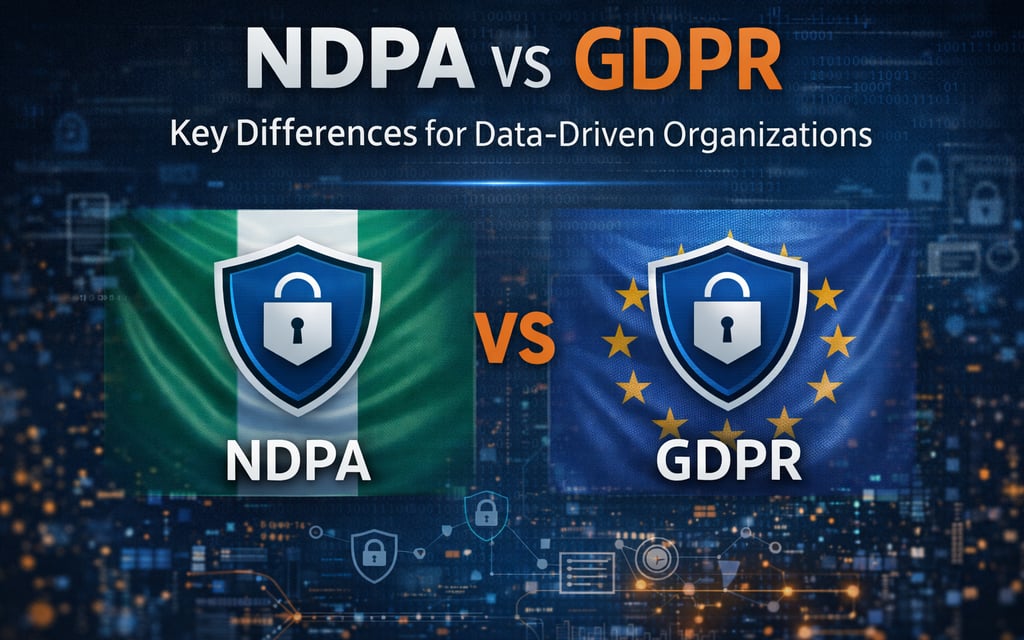
As data-driven business models expand across borders, organizations increasingly find themselves navigating multiple data protection regimes. Two frameworks that frequently intersect for African and international companies are the Nigeria Data Protection Act (NDPA) and the General Data Protection Regulation (GDPR).
While both frameworks are grounded in similar privacy principles—lawfulness, fairness, transparency, accountability, and data security—their scope, enforcement environment, and compliance expectations differ in meaningful ways. Organizations operating in or serving users across Nigeria and the European Union should understand these differences clearly to avoid regulatory exposure and operational confusion.
Scope and Territorial Application
The GDPR applies to organizations established within the European Union, as well as organizations outside the EU that offer goods or services to EU residents or monitor their behavior. Its territorial reach is intentionally broad and extraterritorial in effect.
The NDPA applies to data controllers and processors operating in Nigeria, as well as those outside Nigeria that process the personal data of individuals located in Nigeria. While similar in structure to GDPR in its extraterritorial intent, enforcement and regulatory oversight are exercised by the Nigeria Data Protection Commission (NDPC).
For fintechs and SaaS companies serving both EU and Nigerian customers, dual compliance obligations may arise.
Lawful Basis for Processing
Both GDPR and NDPA require organizations to establish a lawful basis for processing personal data. These include consent, contractual necessity, legal obligation, legitimate interest, and other recognized grounds.
However, GDPR jurisprudence and regulatory guidance have significantly shaped how “legitimate interest” and “consent” are interpreted within the EU. Nigerian enforcement under NDPA is still maturing, but the accountability expectations are increasingly structured and documentation-driven.
Organizations should ensure that lawful basis assessments are documented clearly and consistently across jurisdictions.
Data Subject Rights
Both frameworks recognize fundamental data subject rights, including:
Right of access
Right to rectification
Right to erasure
Right to restrict processing
Right to data portability
The procedural requirements for responding to rights requests are similar, but timelines, documentation expectations, and supervisory engagement processes may differ in practice.
Organizations must implement internal processes that are capable of handling rights requests within statutory timeframes while maintaining evidence of compliance.
Breach Notification Requirements
Under GDPR, personal data breaches must be reported to the relevant supervisory authority within 72 hours of becoming aware of the breach, unless the breach is unlikely to result in risk to individuals.
NDPA similarly requires timely breach notification, with obligations to notify the Nigeria Data Protection Commission and, where applicable, affected individuals.
In both cases, organizations must maintain breach detection, logging, investigation, and response procedures. A well-documented incident management process is critical to demonstrating accountability.
Governance and Accountability Obligations
Both GDPR and NDPA embed the principle of accountability. Organizations must not only comply but be able to demonstrate compliance.
This includes:
Maintaining records of processing activities
Implementing appropriate technical and organizational measures
Conducting risk assessments
Appointing data protection officers or responsible personnel where required
NDPA introduces specific compliance audit obligations for certain organizations, requiring structured assessments and reporting. While GDPR does not mandate periodic “compliance audits” in the same statutory format, supervisory authorities expect demonstrable ongoing compliance.
Enforcement Environment and Regulatory Maturity
GDPR operates within a well-developed regulatory ecosystem across EU supervisory authorities, with a substantial body of enforcement actions and jurisprudence.
NDPA enforcement is comparatively newer but is evolving rapidly. Organizations operating in Nigeria should not assume lower enforcement risk due to regulatory maturity; accountability expectations are increasing, particularly for data-driven and financial services organizations.
Integrating NDPA and GDPR into a Unified Framework
For organizations subject to both frameworks, the most effective strategy is integration rather than duplication. ISO/IEC 27001-aligned governance structures can provide a structured foundation for integrating privacy controls, documentation practices, and accountability measures.
Rather than maintaining separate compliance programs for each jurisdiction, organizations should establish a unified privacy governance framework that maps overlapping requirements while accounting for jurisdiction-specific differences.
Conclusion
NDPA and GDPR share foundational principles but differ in scope, enforcement environment, and operational nuance. Data-driven organizations must treat privacy compliance as an integrated governance function rather than a reactive legal obligation.
A structured assessment can clarify where obligations overlap, where divergence exists, and how best to align operational controls with both regulatory regimes.
Follow us on Socials
Phone
info@securaconsults.com
+2348035333281
© 2026. Secura Consults Ltd. All rights Reserved.